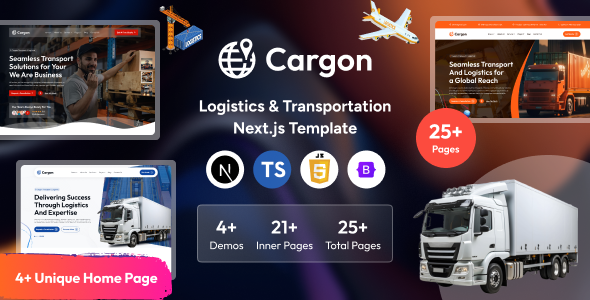
Cargon is a Next.js template built for logistics, cargo, and transportation websites, offering a modern frontend solution for agencies and developers. It's designed for quick deployment of service-based sites.
Cargon: A Next.js Template for Logistics & Transportation Websites
Cargon is a frontend template specifically built with Next.js and React, targeting the logistics, cargo, and transportation sectors. This isn't a full-stack solution, but rather a pre-designed and pre-coded user interface kit to accelerate the development of a modern, performant website for services like trucking, warehousing, or ocean freight. From our experience building client sites, this type of specialized template can drastically cut down initial setup and styling time.
The core value here is getting a well-structured, niche-specific React application without starting from scratch. It solves the headache of building out common page layouts and UI components for a logistics website development project, letting you focus on integrating your specific backend or custom features.
Who Cargon is For (and Who It Isn't)
This template is genuinely useful for web development agencies and freelancers who regularly build sites for clients in the shipping, logistics, or transportation industries. If you need to deliver a fast, modern frontend using a React-based stack and have a solid understanding of Next.js and TypeScript (or JavaScript), this could save you significant development hours. It’s also a good fit for in-house teams looking to quickly launch a new marketing site or refresh an existing one with a contemporary look.
However, Cargon is not for everyone. If you're new to React or Next.js, the learning curve might be steeper than expected, as this isn't a drag-and-drop builder. It’s also not suitable if you require a deeply customized, unique design that deviates significantly from the provided layouts, or if you need a full-stack solution with integrated backend logic out of the box. This is a frontend accelerator, not a complete business application.
Cargon's Core Layouts and Components for Shipping Companies
Cargon provides several distinct homepage demos and a collection of inner pages designed for typical logistics service presentations. When we tested the kit on a demo site, the variety of layouts felt sufficient for most standard service pages, about us, contact, and potentially a basic blog structure.
The template leverages a component-oriented architecture, which means you're working with reusable blocks rather than monolithic pages. This approach makes it easier to mix and match sections or update styles consistently across the site, a practical benefit for ongoing maintenance and future expansions, which translates to lower long-term costs for a business owner.
Developer Experience with Cargon's Next.js Codebase
From a developer's perspective, Cargon appears to be built with a focus on maintainability and modern practices. It uses Bootstrap and Next.js, with options for both TypeScript and JavaScript, which offers flexibility. The codebase is described as "utility and component-oriented," which generally means a cleaner structure than many older HTML templates.
The inclusion of SASS for dynamic color schemes is a practical touch. This allows for quick branding updates without digging through individual CSS files, saving time and reducing the chance of inconsistencies. The stated lack of jQuery dependency is also a plus, contributing to lighter page loads and a more performant application, which directly impacts user experience and Core Web Vitals scores.
Documentation is mentioned as detailed, covering setup and component usage. This is critical for onboarding new developers or quickly understanding how to modify specific sections, reducing the learning curve for your team and making the project easier to hand off.
Ensuring Mobile-Friendly Logistics Website Design
The template is built with Bootstrap, which inherently provides a responsive foundation. In our experience, Bootstrap-based templates generally handle various screen sizes well out of the box. This means your logistics website design will adapt correctly across desktops, tablets, and mobile phones, which is crucial for reaching customers on any device.
A good responsive design isn't just about shrinking images; it's about optimizing the user experience for smaller screens. The component-based approach usually helps here, allowing for better control over how elements stack and display on mobile, ensuring a smooth experience for potential clients looking for transportation services.
Cargon's Foundation for Search Engine Optimization
While a frontend template doesn't guarantee top search rankings, Cargon's Next.js foundation provides a solid starting point for technical SEO. Next.js inherently supports server-side rendering (SSR) and static site generation (SSG), which are beneficial for search engine crawlers as content is readily available without client-side JavaScript execution delays. This can positively impact initial page load metrics important for SEO.
The "well-commented code structure" and "component-oriented" approach suggest a cleaner HTML output, which helps search engines parse content efficiently. A clean semantic structure is also key for accessibility and search engine understanding, contributing to a better overall SEO profile for a logistics company website.
Final Verdict: Is Cargon a Smart Investment for Your Logistics Project?
After building multiple agency sites with tools like this, Cargon stands out as a practical choice for developers and agencies focused on the logistics and transportation niche. It delivers a modern, performant React/Next.js frontend that saves considerable time on initial UI development and styling. The component architecture and SASS integration make it reasonably easy to customize for client branding.
While it won't write your backend or teach you Next.js, it provides a robust, clean foundation for a professional online presence. If you're comfortable with the tech stack and need to rapidly deploy a high-quality logistics website, Cargon is a smart investment that can significantly reduce your project's initial development phase and get you to market faster.
FAQ
Does Cargon include a backend for managing logistics operations?No, Cargon is a frontend template built with Next.js and React. It provides the user interface and structure, but you would need to integrate your own backend services for data management, booking systems, or tracking functionality.
Is this template suitable for someone new to React or Next.js?While the code is well-commented, Cargon is best suited for developers already familiar with React and Next.js. It's not a visual builder, so a basic understanding of these technologies is essential for effective customization and deployment.
How easy is it to change the overall color scheme or branding?Cargon uses SASS for dynamic color schemes, which makes global branding changes relatively straightforward. You can typically update a few SASS variables to adjust the primary and secondary colors across the entire template, saving significant styling time.
What kind of performance can I expect from a Next.js template like Cargon?Next.js templates generally offer excellent performance due to features like server-side rendering, static site generation, and optimized asset loading. This means faster page loads and a smoother user experience, which are beneficial for both visitors and search engine rankings.