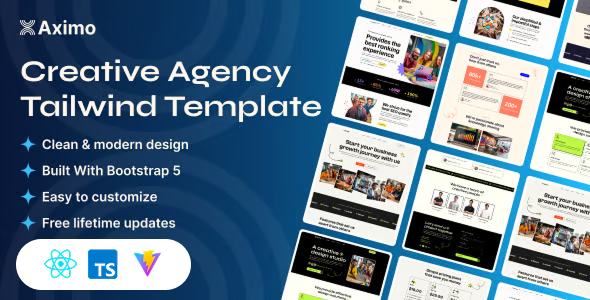
Aximo Creative Agency Tailwind React js Template is a front-end UI kit designed for digital agencies, software businesses, and startups looking to quickly deploy modern, responsive websites without building everything from scratch.
Addressing Agency Workflow Challenges with Aximo's React Template
In our experience building multiple agency sites, a common bottleneck is the initial setup of a clean, performant front-end. This Aximo Creative Agency Tailwind React js Template solves the headache of starting from an empty canvas, particularly for agencies that need to deliver a polished site quickly.
It acts as a solid front-end development accelerator for agencies, saving significant time on styling and basic layout configuration. Instead of spending days on boilerplate, developers can focus on client-specific content and unique features, which translates directly to lower project costs and faster delivery for business owners.
Evaluating Aximo's Front-End Architecture and Development Standards
This template is built on React with TypeScript and uses Tailwind CSS for styling, a combination that indicates a modern development approach. The inclusion of Bootstrap 5.x is interesting; it appears to be primarily for grid layout or possibly a few specific components, while Tailwind handles the utility-first styling. This dual approach can sometimes lead to larger CSS bundles if not carefully managed, but it also offers flexibility if you're comfortable with both.
The code organization feels generally clean. Component files are separated logically, making it straightforward to locate and modify sections. For a non-technical business owner, this means easier long-term maintenance and fewer hours billed for updates, as developers can navigate the codebase efficiently.
- Asset Loading: Fonts are handled via Google Fonts, and icons use Uicons and Font Awesome. This is standard, but developers should be mindful of optimizing font subsets and icon delivery to maintain good Core Web Vitals scores, which impacts SEO and user experience.
- Semantic Structure: The HTML structure appears to follow standard semantic practices. This is crucial for search engine optimization, helping search engines understand the content hierarchy and improving accessibility for users relying on assistive technologies.
- Mobile Responsiveness: The template is built to be fully responsive. The mobile menu implementation is a standard off-canvas pattern, which provides a consistent user experience across devices. This ensures a broad audience can access and interact with the site effectively.
- TypeScript Usage: Using TypeScript adds a layer of type safety, which can significantly reduce bugs and improve code maintainability, especially in larger projects or when multiple developers are involved. This translates to a more stable product and fewer unexpected issues for the client.
Practical Benefits and Strengths of the Aximo Creative Agency Template
What impresses most is the focus on a clean aesthetic that aligns well with current design trends for creative agencies. It avoids the over-the-top animations and bloated features often found in other themes, sticking to a functional and visually appealing design.
The variety of home page layouts provides a good starting point for different agency types, whether a design studio or a more corporate SEO firm. This versatility allows for quick adaptation to a client's specific branding without extensive re-styling.
Who Benefits Most from this React Agency Website Template?
This template is ideal for front-end developers and agencies who are comfortable with React, TypeScript, and Tailwind CSS, and who need a solid foundation to quickly build client websites. It's particularly useful for those on tight deadlines or who want to reduce the initial setup time for a new project. It serves well for building a modern creative portfolio theme or a dedicated business site starter.
It is not for those needing deep custom backend logic integrated into the template itself, as this is purely a front-end solution.
Acknowledging Aximo's Limitations and What Could Be Improved
One area that feels somewhat standard is the integration of Bootstrap alongside Tailwind. While it might provide a familiar grid, it could also introduce some redundancy in the CSS if not managed carefully. A purely Tailwind-based approach might offer a leaner footprint.
Also, while there are multiple home page variations, the underlying component structure across these pages could offer more unique functional differences rather than just layout changes to truly differentiate a creative agency website template from others on the market.
Final Thoughts: Is it worth it?
If you're an agency or a developer regularly building client sites with React, this Aximo template offers a legitimate shortcut. It provides a well-structured, modern front-end that can save significant development hours, allowing you to deliver projects faster and more efficiently. The investment here is in accelerating your workflow and reducing the repetitive setup tasks, which ultimately benefits your bottom line.
FAQ
Does this template include any backend functionality or a CMS?
No, this is a purely front-end React and TypeScript template. It provides the user interface and structure, but you would need to integrate your own backend or a headless CMS like Contentful or Strapi.
How easy is it to customize the styling and branding?
Customizing styles is straightforward if you are familiar with Tailwind CSS. You can modify the Tailwind configuration or add custom utility classes to match your client's branding without digging deep into complex CSS files.
Is the template optimized for search engines out of the box?
The template provides a clean semantic HTML structure, which is a good foundation for SEO. However, full SEO optimization also depends on content quality, meta tags, image alt text, and server-side rendering setup, which would be part of your project implementation.
What is the typical performance impact of using this template?
The template uses modern React and Tailwind, which generally leads to good performance. Actual performance will depend on how you optimize images, manage third-party scripts, and implement any data fetching, but the base structure is lightweight.