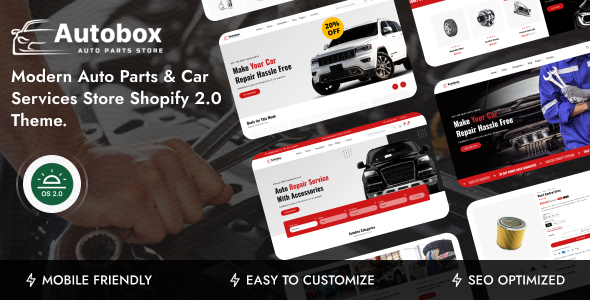
The Autobox Shopify theme for auto parts and car services is a pre-built solution aimed at businesses in the automotive sector looking to quickly launch or refresh their online store presence.
Evaluating the Autobox Shopify theme for auto parts stores
This theme helps teams quickly deploy an online store for selling physical auto parts and accessories. It tackles the initial setup burden for an ecommerce website template for car parts by providing a robust set of common features out of the box, saving significant development time on typical product display and checkout flows. For agencies needing fast turnarounds on client projects, leveraging a theme like Autobox can shave off weeks of custom development for standard ecommerce functionalities.
Technical standards and Shopify OS 2.0 features in Autobox
Autobox is built on Shopify OS 2.0, meaning it utilizes the platform's drag-and-drop sections extensively. This offers a lot of flexibility for content managers to rearrange page layouts without needing developer intervention, which translates to lower ongoing maintenance costs for the business owner. The underlying HTML structure appears clean and semantic, which is a positive for search engine optimization and basic accessibility practices. Asset loading feels reasonably optimized, suggesting the developers considered Core Web Vitals, though real-world performance will always depend on the content added.
In our experience with similar frameworks, the "well-commented HTML & CSS" usually means the code is understandable for modifications, which is a baseline expectation. The theme includes standard features like multi-currency and multi-language support, which are crucial for any serious online auto accessories shop aiming for a broader market.
- The CSS organization is fairly standard for a ThemeForest offering, often relying on utility classes. This means initial overrides might require some specificity, but it's manageable for a developer.
- The mobile menu behavior is as expected, collapsing cleanly and handling longer category lists without issues, which is critical for an auto parts site with many product categories.
- Product media support, including 3D models and AR viewer capabilities, is a strong point. This provides a tangible benefit for showcasing complex auto parts, allowing customers to inspect items closely before purchase, reducing returns.
- The advanced search filter and AJAX storefront filtering are essential for navigating a large catalog of vehicle parts. This directly improves the user experience by helping customers find specific components faster.
Strengths of the Autobox Shopify theme for automotive businesses
What impresses most about Autobox is its comprehensive suite of ecommerce features tailored for a product-heavy store. The inclusion of quick buy, pre-order, stock counters, and various merchandising tools like cross-selling and product reviews provides a solid foundation for a conversion-ready funnel. The ability to display 3D models and use AR for products is a significant advantage for selling automotive components, offering a richer customer interaction than typical image galleries.
Who should use this Shopify theme for car accessories and services?
This theme is well-suited for small to medium-sized auto parts retailers, car accessory shops, and general vehicle service providers looking for a quick and feature-rich deployment on Shopify. It's also a strong contender for agencies handling client projects in the automotive niche that require a robust set of common ecommerce functionalities without extensive custom coding. However, it is not for those needing deep custom backend logic or highly specialized vehicle fitment databases, which are often critical for very niche auto parts suppliers.
Limitations of the Autobox Shopify theme
One notable limitation is the absence of explicit, dedicated vehicle fitment filtering (e.g., "show parts for 2018 Ford F-150"). While the advanced filtering can be configured to approximate this using tags, it’s not a purpose-built solution. For a specialized auto parts store, this often requires a custom app or more complex integration. Additionally, while the default design is functional, it feels somewhat generic out of the box, requiring some effort to establish a unique brand identity beyond just color changes.
Final Thoughts: Is it worth it?
For the right project, Autobox is a worthwhile investment. If you're building an online auto parts shop or an ecommerce website template for car services that relies on common product display, merchandising, and checkout features, this theme can save a substantial amount of development time and budget. The built-in OS 2.0 flexibility means content updates are straightforward, making it a logical step to efficiently launch a capable automotive ecommerce store.
FAQ
Does this theme support dedicated vehicle fitment filters?
No, the theme does not include a purpose-built vehicle fitment filter system. You would need to use Shopify's tag-based filtering or integrate a third-party app for this functionality.
How does the theme handle large product catalogs?
With its advanced search, filtering, and mega menu capabilities, the theme provides the necessary tools for customers to navigate large product inventories effectively.
Is the theme easily customizable beyond the drag-and-drop sections?
Yes, the theme's well-commented code allows developers to customize it further, though it requires familiarity with Shopify's Liquid templating and front-end development.
What about performance for Core Web Vitals?
The theme appears reasonably optimized for speed, but actual Core Web Vitals scores will heavily depend on the images, videos, and third-party apps you integrate into your specific store.