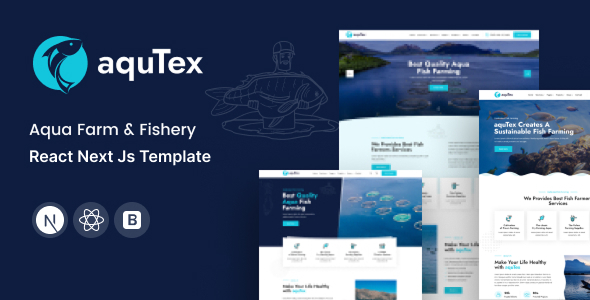
Aqutex is a Next.js template for aqua farm and fishery websites, ideal for agencies and freelancers needing a fast, responsive foundation in aquaculture services.
Aqutex: A Next.js Template for Aquaculture Industry Websites
This Aqutex template positions itself as a specialized Next.js solution for the aquaculture industry. From our perspective, after building multiple agency sites with tools like this, it’s a starter kit designed to get a niche website up and running without building everything from scratch. It provides a foundational structure for businesses involved in fish farming, fisheries services, or any aqua farm business template requirement.
It's not a full-stack application with complex backend logic, but rather a robust frontend package. This focus means less time spent on initial styling and component creation, allowing developers to concentrate on integrating specific business logic or content.
Who Benefits from this Fishery Services Website Design?
This template is for web agencies and freelance developers who regularly take on client projects in the agricultural or environmental sector, specifically focusing on water-based farming. If you need to deliver a modern, performant website quickly for an aqua farm, fishery, or related aquaculture business, this can save significant development time.
It is not for absolute beginners to Next.js or React, as some familiarity with the framework will be essential for customization and deployment. It’s also not ideal for projects demanding highly unique UI/UX that deviates significantly from common web patterns, as adapting a pre-built template for extreme customization can sometimes take longer than building from scratch.
Layouts and Components for Aqua Farm Business
The template includes "unlimited page" and "unlimited blog pages," which means you get a good set of common page structures to begin with, rather than just a few static examples. The "Detailed Oriented Listing" feature suggests components are available for showcasing specific services, farm types, or product listings, which is crucial for a niche like aquaculture where specific offerings need clear presentation.
Having these common layouts pre-built means less time spent on foundational content pages and more time on populating them with client-specific information and conversion-ready funnels.
Code Quality and Developer Experience
Aqutex emphasizes "clean code," "commented code," and "W3 web standards." In our experience with similar frameworks, this usually translates to a more maintainable codebase, which is a huge benefit for long-term client projects. Well-structured code means lower maintenance costs for the business owner down the line, as updates or new features are easier to implement.
The use of Bootstrap as a framework ensures a familiar and well-supported grid system. This makes layout adjustments straightforward for anyone comfortable with Bootstrap. While it doesn't specify SASS architecture, the promise of clean CSS suggests a reasonable file organization, which helps when moving files or changing a color scheme across the entire site.
- Clean & Commented Code: This is a practical win. It means less time trying to decipher someone else's logic and more time building.
- Bootstrap Framework: A standard, widely understood foundation. It simplifies responsive design and component styling.
- Valid Next.js & CSS3 Files: Adhering to web standards typically results in better browser compatibility and a more stable application.
Responsiveness and Cross-Browser Compatibility
The template states "100% Fluid Responsive" and "Tested on real devices," along with "Cross Browser Compatibility." For a business owner, this means their website will look and function correctly across various devices—desktops, tablets, and phones—and different web browsers. This is no longer a luxury but a basic expectation for any modern website, ensuring a consistent user experience and wider audience reach.
A good mobile experience is critical for Core Web Vitals and overall user satisfaction, which directly impacts business engagement.
SEO Readiness for Aquaculture Services
While the description doesn't explicitly detail SEO features, the mention of "clean code" and "valid Next.js & CSS3 Files" implies a foundation for good technical SEO. A clean semantic structure helps search engines understand the content, which is crucial for ranking for specific terms like "fishery services website design" or "Next.js template for aquaculture industry."
The emphasis on "Advanced Typography" and "Pixel Perfect Design" also contributes to a good user experience, which Google increasingly factors into its ranking algorithms. A fast-loading, well-structured site is a strong starting point for any SEO strategy.
Final Verdict: Is Aqutex a Smart Investment?
Aqutex offers a solid, well-structured starting point for developers building aqua farm or fishery websites. It saves significant time on initial setup and design, letting you jump straight into content and specific business features. While it provides a good foundation, remember it's a template, not a custom solution. You'll still need to bring your Next.js and React expertise to truly make it your own and integrate any unique business logic.
The clean code and Bootstrap integration make it relatively easy to maintain and extend, which is a big plus for client longevity. For agencies and freelancers looking to efficiently deliver modern, responsive websites in this niche, Aqutex is a smart investment that can genuinely streamline your workflow.
FAQ
Is this template suitable for someone new to Next.js?While the code is clean, some familiarity with Next.js and React concepts is recommended to effectively customize and deploy this template.
Can I easily change the overall design and branding?Yes, the use of Bootstrap and clean CSS means that basic styling changes, like colors and fonts, should be straightforward for a developer to implement across the site.
Does this template include any backend functionality for managing farm listings or bookings?No, this is a frontend Next.js template. It provides the visual structure and client-side logic, but you would need to integrate your own backend services for data management or booking systems.