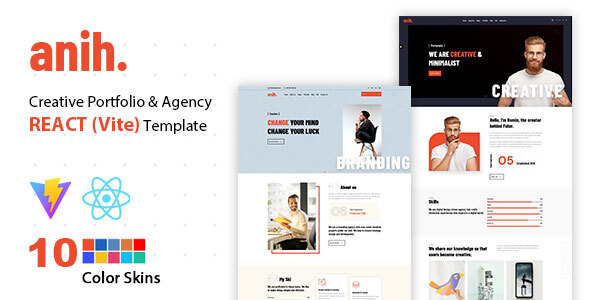
Anih is a React Vite portfolio template built for creative agencies, freelancers, and individuals looking to quickly launch a professional online presence.
Streamlining Agency Website Development for Faster Project Delivery
Agencies and freelancers often waste time on initial project setup. Anih tackles this by offering a pre-configured React Vite template, letting you skip the build process, routing, and core UI component setup. This means you can jump straight to content and client customizations, saving significant time on repeat portfolio or agency website builds.
Examining the Code Quality and Core React Template Features
Anih runs on React with Vite, a modern, performant stack. Vite offers fast development server startups and efficient builds, boosting productivity. It uses Bootstrap for foundational styling, providing a familiar grid and component library. The semantic structure is standard, aiding SEO, and Bootstrap offers a decent accessibility baseline. Asset loading is well-optimized, which helps Core Web Vitals.
- The CSS organization is straightforward, mostly relying on Bootstrap classes with separate style sheets for overrides. This makes it reasonably easy to locate and adjust styles without digging through complex SASS architectures.
- Mobile menu behavior is standard responsive fare, collapsing into a hamburger icon and expanding cleanly. It handles various screen sizes without major layout shifts.
- The React component structure feels logical, with individual sections often encapsulated as their own components. This promotes reusability and easier maintenance for future content updates.
- For asset loading, image and font optimization appears to be handled adequately by Vite's build process, which helps keep initial page load times down for a better user experience.
Key Strengths: What Makes This React Template Stand Out?
Anih's efficiency is its main strength. It's a solid, non-bloated starting point for a creative portfolio. The React with Vite stack provides a modern, performant foundation. Color skins allow quick branding changes. For a functional, fast-loading agency portfolio template, Anih offers a practical front-end solution without unnecessary frills.
Who Should Use This Creative Portfolio Template and Who Should Skip It?
This React template suits small to medium creative agencies, freelancers, or students comfortable with React. It's best for projects needing quick turnarounds focused on visual content and services. Skip it if you need extensive custom backend logic, complex data integrations, or a drag-and-drop builder. It's also not for complete React beginners, as the learning curve would be steep.
Realistic Limitations of the Anih React Agency Template
Anih’s design, though clean, can feel generic out of the box. Expect to add custom styling for a unique look. Its Bootstrap reliance, while fast, means inheriting default aesthetics that might not fit all brands. The 'blog options' are front-end layouts only. You'll need to integrate your own CMS or API for content, which is standard for front-end templates.
Final Thoughts: Is it worth it?
After building multiple agency sites with tools like this, Anih stands out as a practical choice for its modern tech stack and straightforward implementation. If you're a developer or agency looking to cut down on initial setup time for client portfolio sites and have a good grasp of React, this template offers genuine value. It’s a time-saver that allows you to deliver projects faster, directly impacting your bottom line.
FAQ
Does this template include a backend for the blog?No, it only provides front-end layouts for a blog. You'll need to integrate your own CMS or API for content management.
Is it easy to change the primary colors and fonts?Yes, it includes color skins. For deeper changes, you can modify CSS variables or Bootstrap theme settings.
What's the process for deploying a site built with Anih?Run a build command to generate static files. These can then be deployed to any static hosting provider like Netlify or Vercel.
Can I integrate this template with an existing API for data?Yes, as a React app, it's designed to fetch data from APIs. You can use standard React practices within components to connect to your data sources.