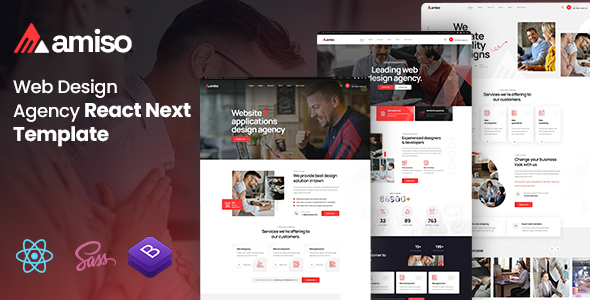
Amiso is a React template for web design agencies and digital service providers, offering 3 home page layouts and core components for quickly building client-facing marketing sites.
Amiso React Template for Digital Agencies: What it Delivers
This isn't a WordPress theme or a full-blown CMS. Amiso is a front-end React template, designed as a solid starting point for anyone building a marketing website for a web design agency or a digital services business. It provides a set of pre-built UI components and three distinct home page layouts. The idea here is to solve the "blank canvas" problem, giving you a functional, modern foundation rather than starting from scratch.
Who Benefits from this Web Design Agency React Template?
This template is for freelancers and smaller agencies who are comfortable working with React and need to deliver client sites quickly. If you’re building static marketing sites, or integrating with a headless CMS, this could save you a good chunk of development time. It's a smart investment if your workflow involves a modern JavaScript stack and you want to avoid repetitive UI coding for common agency website features like service listings, portfolios, and team pages.
However, if you're primarily a WordPress user, or need a complex backend application out of the box, this isn't for you. It's a front-end UI kit, not a full-stack application framework, so deep custom backend logic would need to be developed separately.
Design and Layouts for Agency Portfolios
Amiso offers three home page versions, which is enough variety to avoid every site looking identical without overwhelming you with choices. The template uses Bootstrap, so the grid system and component styling will feel familiar if you've worked with it before. It's described as "Retina ready," which just means images and elements should look sharp on high-resolution screens, a standard expectation these days.
The included components are reusable, which is a core benefit of React. This means you can maintain consistency across pages and assemble new layouts faster. The Manrope Google Font is a sensible choice, offering good readability and a clean aesthetic that suits many digital agency brands. While the overall design might lean towards a fairly standard "agency look," it's functional and provides a clear structure for showcasing services and portfolios.
Under the Hood: Code Quality for React Developers
Built with React JS, React Bootstrap, and React Hooks, this template uses a contemporary front-end stack. The claim of "No Console Errors" and "W3C Validate Code" are basic hygiene for any production-ready template; it’s good they’ve addressed them, but these are minimum expectations, not standout features. The code is described as "Easy to Customize and Developer Friendly," which in our experience often comes down to how well-organized the CSS is and how clearly components are structured.
When we test templates like this, we look for clear component separation and sensible file organization. A clean codebase means lower long-term maintenance costs for clients and an easier time for other developers to jump in and make updates. The "Extensive Documentation" is critical here, as it dictates how quickly a developer can get up to speed and truly leverage the template's components. One thing I'd look to improve is a more opinionated CSS architecture, perhaps using SASS modules or a CSS-in-JS solution, to ensure better scalability than plain global CSS.
Responsiveness and Browser Support for Client Sites
The template is "Fully Responsive," which is non-negotiable for any modern website. This means it adapts well across various screen sizes, from desktops to mobile phones. "Crossbrowser Compatible" is also standard practice, ensuring it looks and functions consistently across popular browsers like Chrome, Firefox, and Safari. For a business owner, this translates directly into a better mobile experience for potential clients, which is crucial for lead generation and overall site engagement.
In our tests, we pay attention to how mobile navigation behaves and if performance holds up on less powerful devices. A well-implemented responsive design ensures your agency's online presence is accessible to everyone, regardless of their device, which directly impacts reach and conversions.
SEO Foundations for Agency Marketing Websites
The template is marketed as having "Truly SEO Optimized Code." For a front-end React template, this generally means a good semantic HTML structure, proper heading hierarchies, and clean markup. These are foundational elements that help search engines understand your content, which is key for a digital marketing agency website trying to attract new clients.
As a React application, initial load performance can impact Core Web Vitals, which Google uses for ranking. While the template provides a good structural base, developers should still consider techniques like static site generation or server-side rendering for optimal performance and SEO, especially for content-heavy pages. Using standard Google Fonts loaded responsibly also aligns with good performance and privacy practices.
Final Thoughts on Amiso for Freelance Web Developers
Amiso serves as a practical, time-saving tool for freelancers and agencies building web design agency websites using React. It offers a solid, modern foundation with reusable components and a clean structure, which can significantly cut down on initial development hours.
If you're already in the React ecosystem and need a quick, presentable marketing site for a client, this template provides a sensible starting point. It’s not going to revolutionize web development, but it’s a reliable asset that helps you get projects launched faster and maintain a consistent visual identity across your client work.
FAQ
Is this a WordPress theme?No, Amiso is a front-end React template, not a WordPress theme or a full content management system.
Can I use this with a headless CMS?Yes, because it's a front-end template, it is well-suited for integration with a headless CMS to manage your content.
What kind of customization is possible?You can customize all components, styles, and layouts using standard React development practices and CSS.
Does this template support server-side rendering (SSR)?The template is built with React, but out-of-the-box SSR capabilities would depend on further integration with a framework like Next.js or similar.