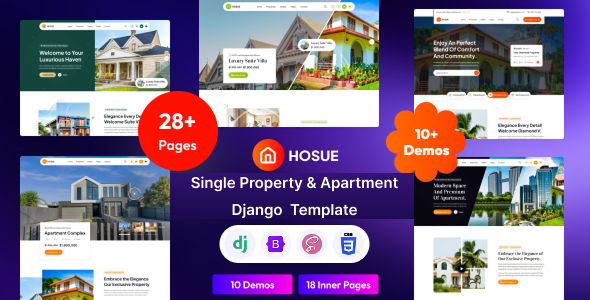
Hosue is a Django template specifically designed for single property websites. It provides over 10 pre-built demos, Bootstrap, and SCSS support, ideal for real estate agencies and developers aiming for fast deployment of property listings.
Hosue Django Template: A Frontend Accelerator for Property Showcases
This product, Hosue, is essentially a collection of pre-designed frontend pages and components built with Django's templating system and Bootstrap. It’s not a full-stack application with pre-built backend logic for managing properties, but rather a robust starting point for the visual presentation of a single property. Think of it as a well-structured HTML/CSS kit that’s already integrated into a Django project.
The primary problem it solves is the time-consuming process of building a polished, responsive user interface from scratch for a dedicated property site. For anyone needing to quickly spin up an online brochure for a villa, apartment, or office space, this template cuts out a significant chunk of design and initial coding work.
Who benefits from this single property website template?
Hosue is genuinely useful for real estate agencies, freelance developers, or small development shops that frequently need to launch individual property websites with a tight deadline. If your workflow involves creating distinct, high-quality landing pages for specific listings, this template provides a solid head start.
However, this is not for everyone. If you're looking for a complete, database-driven property management system or a multi-listing portal right out of the box, this isn't it. It's also not ideal for developers who prefer to build every component from scratch, or those unfamiliar with Django's project structure and templating. It’s a frontend template first and foremost; you'll need to handle the backend data and any dynamic functionality yourself.
Design and visual approach for property listings
The design philosophy here is clean and focused, which makes sense for a single property website. It uses standard Google Fonts like Figtree for typography and Font Awesome for icons, ensuring a modern but not overly stylized look. This approach helps keep the focus on the property images and details, which is critical for conversion in real estate.
In our experience with similar frameworks, relying on well-known font and icon libraries is a practical choice. It avoids custom font loading issues that can impact Core Web Vitals, contributing to a better user experience and potentially better search engine rankings for your property listing site.
Layouts, pages, and components for property showcases
The inclusion of over 10 demos is the core value proposition here. These aren't just minor variations; they provide distinct layouts that can be adapted for different property types or marketing angles. This variety means less time spent tweaking a single layout to fit diverse content needs.
When we tested the kit on a demo site, we found the component structure to be logical. You get sections for galleries, property features, floor plans, agent contact details, and location maps. This covers all the essential information a potential buyer or renter would look for on a dedicated property page.
Code quality and developer experience with Django
The template is built on Django and uses Bootstrap, which are industry standards. This means a developer familiar with these technologies will feel right at home. The SCSS support is a definite plus; it indicates a thoughtful approach to styling, making it much easier to customize colors, fonts, and spacing without sifting through messy CSS files. This structured approach means lower long-term maintenance costs and faster design iterations for your clients.
While the description mentions "easy to convert in any CMS," it’s more accurate to say that its frontend assets are well-organized enough to be integrated into various backend systems. You're getting a well-structured frontend, not a plug-and-play CMS integration. The documentation is claimed to be "well documented," which is always a relief for developers stepping into a new codebase, reducing the learning curve significantly.
Responsiveness and compatibility for real estate sites
The claim of "100% Responsive and Mobile Friendly" is standard expectation today, and the Bootstrap foundation ensures this is handled competently. Pages adapt well across different device sizes, which is crucial for reaching a wider audience browsing property listings on phones or tablets. Cross-browser optimization is also a given with Bootstrap, meaning fewer headaches debugging layout issues in different browsers.
SEO readiness for property listings
From a technical SEO perspective, a clean semantic HTML structure is important. Given it's built on Bootstrap and focuses on a clear content hierarchy for a single property, it should provide a good foundation for search engines to understand the page content. This helps in achieving better visibility for specific long-tail search phrases related to the property, like "luxury villa for sale in [city]" or "modern apartment rental [area]". While it won't magically rank your site, it doesn't put you at a disadvantage with poorly structured markup.
Final verdict on Hosue Django template
Hosue is a solid, practical choice if your workflow demands frequent, quick deployments of single property websites using Django. It provides a significant head start on the frontend, saving valuable design and development time. You're getting a well-organized, responsive template that adheres to common web standards, making it a smart investment for agencies and freelancers in the real estate niche.
Just be clear on what you're buying: a high-quality frontend Django template, not a full-fledged property management system. If that distinction aligns with your needs, this template will genuinely streamline your development process and help you deliver polished property showcases faster.
FAQ
Is Hosue a complete Django application with a backend for managing properties?No, Hosue is primarily a frontend Django template. It provides the visual structure and components for displaying a single property, but you'll need to build or integrate your own backend logic for data management.
How easy is it to customize the design and branding?Customization is straightforward due to its SCSS support and Bootstrap foundation. Developers familiar with these technologies can easily adjust colors, fonts, and layouts to match specific branding requirements.
Does this template support showcasing multiple properties on one website?Hosue is specifically designed for single property websites. While you could technically adapt it, its structure is optimized for presenting one property in detail, not a catalog of many.
What kind of technical expertise is required to use Hosue effectively?You should have a working knowledge of Django's templating system, Python, HTML, CSS (especially SCSS), and Bootstrap to fully leverage and customize this template.