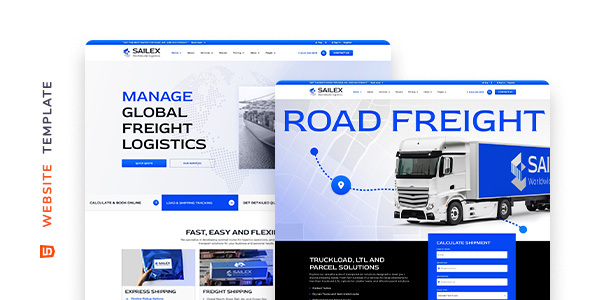
Sailex is a static HTML template for logistics, transportation, and cargo services, built with Bootstrap and SCSS. It's a solid starting point for agencies and freelancers needing a fast, clean frontend.
Sailex: A Practical HTML Template for Logistics Businesses
Alright, let's talk about Sailex. This isn't a WordPress theme or a full-stack application; it's a static HTML template. Specifically, it targets the logistics, transportation, and cargo service niches. What it does well is provide a ready-made frontend structure, which can save a significant chunk of time if you're building a straightforward marketing site or a landing page for these types of businesses.
It solves the initial setup headache of laying out common sections like services, routes, and pricing. Instead of starting from scratch with a blank slate, you get pre-built pages that are visually aligned with what clients in this sector typically expect.
Who Needs This Logistics Company Website Template?
From our experience building multiple agency sites, Sailex is genuinely useful for agencies and freelancers who need to spin up a client site quickly. If your project has a tight deadline and the client just needs a polished, informational presence without complex backend integrations, this template is a strong contender. It's also a good fit if you're comfortable with static HTML and want a solid foundation to build upon.
However, it's not for everyone. If you need deep custom backend logic, a content management system, or integrated CRM functionalities right out of the box, you'll be adding those yourself. This is purely a frontend asset. It’s also not ideal for someone looking for a drag-and-drop builder experience; you'll need to get into the code to customize it properly.
Core Pages and Components for Cargo Service HTML Layouts
Sailex comes with a decent set of pages that cover the basics for a logistics or transportation company. You get standard layouts for About Us, Services, Routes, Pricing, Blog, FAQ, and Contact. The Service Pages are particularly useful, as they provide a structure for detailing different offerings like air freight, sea shipping, or road transport.
The Routes section is a smart inclusion for this niche, offering a visual way to represent service areas or common shipping lanes. While it’s a static representation, it sets the stage for a more interactive map if the client needs one later. The Pricing page offers a clean way to present different service tiers or cost calculators, though any actual calculation logic would need custom JavaScript and backend integration.
- About Us page provides a standard company overview.
- Service Pages offer dedicated layouts for detailing logistics offerings.
- Routes section helps visualize service areas.
- Pricing layout allows for clear presentation of service costs.
- Blog Pages are included for content marketing efforts.
Developer Experience and Sailex Code Structure
Under the hood, Sailex is built with Bootstrap and SCSS, which is a fairly standard and reliable combination. The SCSS files are well-organized, making it easier to jump in and tweak variables, colors, or typography without digging through a monolithic CSS file. This structured approach means lower maintenance costs down the line, as updates or style changes are more straightforward to implement.
The HTML is clean and commented, which is always appreciated. It helps new developers on a project understand the structure quickly, reducing onboarding time. When we tested the kit on a demo site, changing primary colors or font stacks felt intuitive, thanks to the SCSS architecture. This kind of organization is a step above many market-average templates that just dump everything into one giant CSS file.
Ensuring Mobile-Friendly Transportation Website Frontend
Responsiveness is a given with Bootstrap, and Sailex handles various screen sizes as expected. The layouts adapt well from desktop to tablet to mobile, ensuring a consistent user experience across devices. This is crucial for logistics companies whose clients might be checking shipment statuses or service details on the go, leading to better mobile engagement.
Cross-browser support is also standard. We didn't encounter any major rendering issues in common browsers like Chrome, Firefox, Safari, or Edge during our checks. This means fewer browser-specific bug fixes, which saves development time and ensures a wider audience can access the site without problems.
Technical SEO Foundations for Logistics Sites
The clean HTML5 structure and well-organized code contribute positively to technical SEO. Semantic HTML elements are used appropriately, which helps search engines understand the content hierarchy. While a static template doesn't offer dynamic SEO features, this solid foundation means you're starting with good bones for search engine visibility.
Because it's a lightweight static template, it has the potential for excellent page load speeds and Core Web Vitals scores, provided assets are optimized. Fast loading times directly impact user experience and can give you an edge in search rankings, ultimately leading to more organic traffic for the business owner.
Sailex: A Solid Choice for Logistics Website Development
Overall, Sailex is a straightforward, no-nonsense static HTML template. It delivers exactly what it promises: a clean, responsive frontend for logistics and transportation businesses. It won't reinvent the wheel, but it provides a very practical starting point that saves you the initial grunt work of setting up common layouts and styling.
The main limitation, as with any static HTML template, is the lack of a backend. You'll need to integrate a CMS or custom functionality if the project scales beyond a brochure site. However, for agencies and freelancers needing to deliver a professional-looking site quickly and efficiently, this template offers a significant head start. It's a smart investment to cut down on initial development hours and focus on client-specific customizations rather than foundational setup.
FAQ
Does Sailex come with a fully functional cargo calculation system?No, Sailex is a static HTML template and does not include backend functionality for dynamic features like cargo calculation. You would need to integrate a custom solution for that.
Is Sailex built with a content management system like WordPress or Joomla?Sailex is a static HTML template, meaning it does not come with an integrated content management system. Content updates require direct editing of the HTML files.
What's involved in updating the template if new Bootstrap versions are released?Updating to a new Bootstrap version would be a manual process, requiring you to review changes between versions and adapt the template's code accordingly, as there's no automated update path.
Can this template handle complex, dynamic data displays for real-time tracking?As a static HTML template, Sailex provides the visual layout but not the underlying logic for complex, dynamic data like real-time tracking. Such features would require custom JavaScript and backend integration.