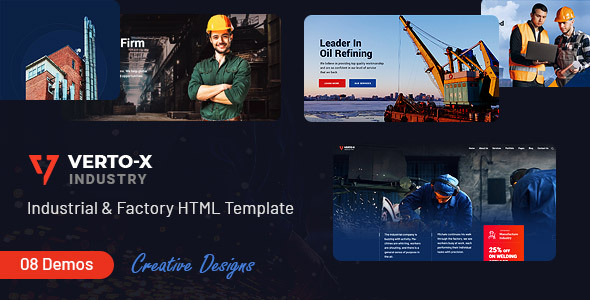
The Vertox Industry and Engineering HTML template is a foundational starter kit for industrial, manufacturing, or engineering websites, suitable for agencies needing rapid deployment of a solid, content-rich site.
Streamlining Industrial Website Development for Agencies
Building industrial client websites demands balancing robust information with a professional aesthetic under tight deadlines. This Vertox HTML template offers pre-built layouts tailored for manufacturing and engineering firms, significantly cutting initial design and frontend development hours.
It’s a smart investment for agencies to reduce project setup time, allowing focus on content and client-specific features over foundational styling.
Technical Standards and Key Features of this Engineering HTML Template
Technically, Vertox uses a standard Bootstrap framework, making its CSS and component structure familiar. Its clean semantic structure aids SEO and maintainability, reducing long-term costs.
Specific layouts for galleries, services, and team pages directly support industrial content needs. While lacking the newest frontend tooling, the HTML and CSS are straightforward, accessible for many.
- The CSS organization follows a typical Bootstrap pattern, simplifying style overrides.
- Mobile responsiveness, managed by Bootstrap's grid, ensures a consistent user experience across devices.
- Asset loading feels standard for its era, so manual optimization of images and fonts is crucial for Core Web Vitals.
- The markup provides a clean semantic structure, good for accessibility and search engine crawlers.
- A working PHP contact form is included, practical for lead generation, requiring server-side configuration.
Strengths and What Impresses about this Manufacturing Website Template
Vertox’s direct focus on the industrial niche stands out; it avoids being a generic multi-purpose template. The layouts are practical for showcasing services, projects, and company information without unnecessary frills. This focused approach means less time removing irrelevant components, which, in our experience, is a significant time-saver.
Who is this Industrial HTML Template For?
This Vertox template is ideal for freelance developers or small agencies building credible online presences for industrial, manufacturing, or engineering clients. It suits projects needing a professional, information-heavy site without complex interactive features or custom backend logic. Avoid it if you require a highly dynamic application frontend or a deeply customized UI framework.
Limitations of the Vertox Engineering Template
One average aspect is its reliance on an older Bootstrap version, meaning it lacks the latest CSS features or component improvements. The Revolution Slider, though visually impactful, can contribute to heavier page loads if not carefully optimized, potentially impacting Core Web Vitals.
Final Thoughts: Is it worth it?
If you're an agency or developer needing to deliver a robust, content-focused website for an industrial client on a budget and tight timeline, the Vertox Industry and Engineering HTML Template offers a pragmatic starting point. It provides a solid, industry-specific foundation that saves significant design and initial frontend development time, enabling efficient delivery of a professional product.
FAQ
Does this template use modern CSS features?The template is built on an older version of Bootstrap, relying on established CSS practices rather than the newest features like CSS Grid or custom properties.
How easy is it to change the primary brand colors?Changing primary brand colors involves updating the main CSS files. While straightforward for a developer, it's a manual process as there isn't a built-in theme customizer.
Is the template optimized for fast loading speeds?While the core HTML and CSS are reasonably lean, achieving optimal loading speeds will require manual image optimization, font loading adjustments, and potentially removing unused assets, especially from the Revolution Slider.
Can I easily integrate this with a content management system?Yes, as a static HTML template, integrating it with any CMS involves slicing the HTML into the CMS's templating language, which is a standard development process.