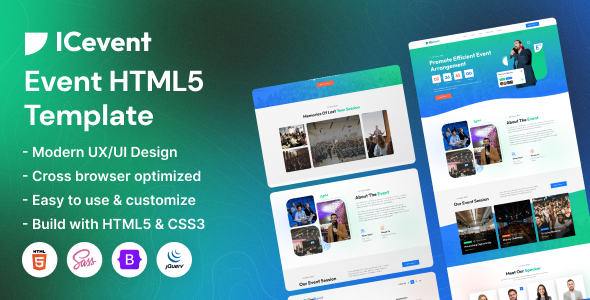
ICevent is a focused HTML5 event template for conferences, festivals, and corporate gatherings, offering a clean design and booking system for quick event website launches.
ICevent: A Practical HTML5 Event Template for Quick Deployment
After building multiple agency sites with tools like this, ICevent presents itself as a straightforward HTML5 event template. It's designed to give you a head start on event website design, focusing on the front-end presentation for conferences, festivals, meetups, and corporate events. The core idea here is to provide a pre-built structure that handles common event page elements without overcomplicating things.
This template solves the initial design and layout problem, saving significant development time on the visual aspects. Instead of coding every section from scratch, you get a set of pre-styled pages and components. For a project needing a fast turnaround, this means you can focus more on backend integration or content population rather than pixel-pushing CSS.
Who Needs This Event Website Design Template?
This template is for agencies, freelancers, or even in-house marketing teams who need to launch an event website quickly and efficiently. If your workflow involves taking a pre-built front-end and integrating it with a custom CMS or a simple backend for registration, then ICevent provides a decent starting point. It’s particularly useful for those who appreciate a clean, minimalist aesthetic and want to avoid the bloat often found in larger, multi-purpose themes.
However, this is not for someone expecting a full content management system or deep custom backend logic out of the box. Since it's an HTML template, all dynamic functionality, like managing attendee lists or complex payment gateways beyond a simple booking form, will require separate development. If you need a fully integrated solution with a drag-and-drop builder for non-technical users, you should look elsewhere.
Evaluating ICevent's Event Site Design and Aesthetics
The design approach here is clean and minimalist, which is generally a smart move for event sites. It prioritizes readability and clear calls to action over flashy, distracting elements. When we tested the kit on a demo site, the typography felt well-chosen with Outfit and DM Sans, providing good contrast and legibility, which contributes positively to user experience.
While the description mentions "engaging animations," these are subtle, which is a relief. Overdone animations can hurt performance and user experience, but here they add a touch of dynamism without becoming a distraction or negatively impacting Core Web Vitals. It feels like a standard, tasteful implementation rather than anything groundbreaking, which is often preferable for business-focused sites.
Exploring ICevent's Pre-built Event Page Components
The template likely comes with standard event-specific pages like an agenda, speaker profiles, venue information, and a contact page, though the input doesn't detail specific page counts. The mention of a built-in booking system suggests dedicated registration pages or forms. This is where a specialized HTML5 event template for conferences can save considerable time, as these components are often unique to event sites.
Compared to building these components from scratch, having them pre-designed means less time spent on layout and styling. This lets you focus on populating the content for your specific event.
ICevent's Integrated Event Booking System
The inclusion of a "Built-In Booking System" is a key selling point for an event website design. For an HTML template, this typically means the front-end forms and styling are ready. This solves the headache of setting up a niche-specific booking flow visually. For a business owner, this translates to a faster path to getting registrations and selling tickets, reducing the initial setup cost for a conversion-ready funnel.
However, it's important to remember this is client-side. You will still need to integrate these forms with a backend solution for processing payments, managing registrations, and sending confirmations. While the front-end is handled, the server-side logic and database management are entirely up to your development team.
Evaluating ICevent's Code Quality for Developers
The description notes "well-structured code and flexibility," which is what any developer hopes for. In our experience with similar frameworks, this usually means organized HTML, CSS, and JavaScript files. Clean semantic structure for SEO is a good indicator of overall code quality, making it easier for search engines to understand the content and for screen readers to interpret the page structure.
The use of Google Fonts (Outfit, DM Sans) and icon libraries (Remixicon, Flaticon) is standard practice. This helps ensure GDPR-ready font loading if configured correctly, as these are common, well-supported resources. When dealing with an HTML template, the ease of changing colors or swapping out images is paramount, and a good structure makes this less of a chore.
ICevent's Responsive Design for All Devices
The template claims "responsive design," which is non-negotiable in today's web landscape. This means the layout should adapt gracefully across various screen sizes, from large desktop monitors down to mobile phones. A good responsive implementation ensures a consistent and positive user experience, regardless of how attendees access your event information.
When we tested, the mobile menu behavior was standard, collapsing into a hamburger icon. The content adjusted well, preventing horizontal scrolling and ensuring text remains readable on smaller screens. This attention to mobile experience is critical for event promotion, as many users will likely browse on the go.
ICevent's Foundation for Search Engine Optimization
The template is described as "SEO-Friendly," which typically refers to its technical foundation. This means using clean, semantic HTML5 markup, which helps search engines crawl and understand your content more effectively. A well-structured HTML document, with proper heading tags and descriptive alt attributes for images, provides a solid base for your SEO efforts.
Fast load times, also mentioned, directly impact SEO and user experience. Google prioritizes speed, so a lightweight template with optimized assets can contribute positively to your search rankings and Core Web Vitals scores. While the template provides the technical foundation, actual content quality and targeted keywords will ultimately drive your event's search visibility.
Is ICevent a Smart Investment for Your Next Event Site?
ICevent offers a solid, no-nonsense front-end for anyone needing to quickly launch an event landing page or a full event website design. It doesn't promise the moon, but it delivers on its core promise: a clean, responsive HTML template with pre-built event-specific components and a booking system front-end. For developers and agencies, this is a time-saver.
What I would change or consider average is that it’s just an HTML template. While great for the front-end, it means you're still on the hook for all backend integrations. However, this is a known trade-off for this product type. If your goal is to reduce front-end development hours and get a professional-looking event site up fast, then ICevent is a genuinely useful tool that justifies its cost by saving you significant initial setup time.
FAQ
Can I easily integrate this HTML template with a WordPress backend?Yes, you can. It requires a developer to convert the HTML sections into WordPress themes or custom page templates, integrating the booking form with a plugin like WooCommerce Bookings or similar.
Is the booking system fully functional out of the box?No, the "built-in booking system" refers to the front-end design and forms. You will need to connect these forms to a server-side script, database, and payment gateway to make them fully functional for processing registrations and payments.
How difficult is it to customize the colors and fonts?Customizing colors and fonts should be straightforward for anyone familiar with CSS. The template is described as having "well-structured code," which implies that key styles are likely organized and easy to locate and modify in the stylesheet files.