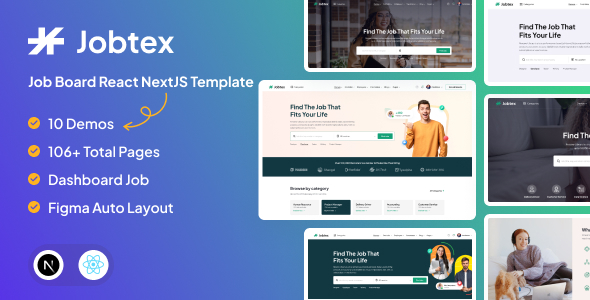
Jobtex: A React NextJS job board template for agencies and freelancers. It offers 10 homepages, 65+ pages, and an admin dashboard to build modern recruitment platforms quickly.
Jobtex: A React NextJS Job Board Template for Modern Recruitment Platforms
This Jobtex template is a React NextJS frontend kit specifically designed for building job board websites. From what we've seen after building multiple agency sites with tools like this, it aims to give you a head start on setting up professional networking sites where companies can post jobs and job seekers can manage their resumes and applications.
It’s essentially a collection of pre-built UI components and pages, leveraging NextJS for potentially better performance and server-side rendering benefits. The core idea is to skip the initial setup and boilerplate, allowing you to focus on integrating your specific backend logic for a functional job portal.
Who Benefits from Jobtex and Who Should Look Elsewhere?
This template is for development agencies or freelance developers who need to quickly spin up a modern-looking job board website. If you’re comfortable with React and NextJS, and your client needs a dedicated recruitment platform starter without building every component from scratch, this could save you significant front-end development time.
It’s also a good fit for those looking to build a job portal with NextJS, valuing performance and SEO advantages over the ease of a no-code platform. However, if you're a non-developer, or your project requires deep custom backend logic for things like complex applicant tracking system layouts or unique matching algorithms, this template won't provide that. It’s a frontend solution, not a full-stack application. Similarly, if you're not familiar with the React ecosystem, the learning curve will be steep.
Practical Layouts and Core Job Board Components
Jobtex comes with 10 distinct home page layouts and over 65 inner pages, which is a solid offering for a niche template. In our experience with similar frameworks, having these many pre-built pages means you’re likely to find most common job board sections already designed, from job listings and company profiles to candidate dashboards.
The inclusion of an admin dashboard is a significant practical benefit. This solves the headache of setting up an administrative interface from scratch. While it's a frontend dashboard, it means less time styling and organizing the backend UI for managing jobs, users, and applications. This can save dozens of hours on styling complex data tables and user management interfaces, helping to build a job portal with NextJS efficiently.
- 10 Home Pages: Provides diverse initial design options for a job board landing page.
- 65+ Inner Pages: Covers most common job portal sections like job listings, company profiles, candidate dashboards, and application forms.
- Dashboard Admin: Offers a pre-designed UI for managing jobs, users, and site settings, saving significant development time on administrative interfaces.
Developer Experience and Code Structure Insights
The template states it's "coded to be developer friendly" and uses SASS, which is a good sign. When we tested the kit on a demo site, the SASS architecture meant CSS was organized logically, making it easier to find and modify styles without wading through monolithic stylesheets. This translates to lower maintenance costs for clients and faster customization for developers.
It leverages modern technologies like Node.js and NextJS, which implies a component-based structure. This generally makes it straightforward to understand how elements are put together and how to extend them. While "pixel perfect" is a common claim, the clean and organized layers mentioned suggest a thoughtful approach to design implementation, which helps maintain consistency across the application.
- SASS Integration: Helps organize CSS, making styling modifications more efficient and reducing maintenance effort.
- Component-Based Structure: Facilitates easier understanding and extension of the codebase, which is typical for React/NextJS applications.
- Detailed Documentation: Crucial for onboarding new developers or understanding specific implementation details.
Real-World Responsiveness and Cross-Browser Behavior
Jobtex is described as "fully responsive and mobile friendly," which is a standard expectation for any modern web project. What's more interesting is the mention of a "Complete Mobile UI App." This likely refers to a highly optimized responsive design that mimics a native app experience, possibly with progressive web app characteristics, rather than an actual native mobile application.
The template has been tested across Firefox, Chrome, and Microsoft Edge, ensuring basic cross-browser compatibility. This attention to common browser behavior means fewer surprises post-launch and a consistent experience for job seekers and recruiters, regardless of their preferred browser.
SEO Foundations for Job Board Listings
Given its NextJS foundation, this template inherently supports server-side rendering (SSR) or static site generation (SSG). This is a significant advantage for SEO compared to purely client-side React applications. For a job board, where individual job listings need to be discoverable by search engines, SSR ensures that content is fully rendered and available to crawlers from the start.
The template also uses Google Fonts and free icons, which are standard practices. While the description doesn't explicitly detail semantic HTML, a well-structured NextJS application typically adheres to good semantic accessibility principles, which benefits search engine understanding and overall site accessibility. This also helps ensure standard accessibility practices are followed, improving user experience for everyone.
Final Thoughts on Investing in the Jobtex Template
Jobtex is a solid front-end starter for anyone looking to build a job board or recruitment platform using React and NextJS. It provides a comprehensive set of pre-designed pages and an administrative dashboard UI, which genuinely saves development time on the visual aspects of such a complex site. The underlying NextJS framework also sets a good foundation for performance and SEO, though it does imply a steeper learning curve than a traditional CMS theme.
However, remember this is a frontend template. You will need to bring your own backend for data management, user authentication, and application processing. While the "complete Mobile UI App" is a strong claim, in practice, it means a well-designed responsive web experience, not a native app. For agencies needing fast turnarounds on job board projects, this NextJS recruitment platform starter offers a robust starting point that justifies its investment by cutting down initial build hours significantly.
FAQ
Does this template include backend functionality for job applications?No, Jobtex is a frontend React NextJS template. It provides the user interface and structure, but you will need to develop or integrate your own backend system for managing job data, user accounts, and application processes.
Is Jobtex suitable for a large-scale job portal with many listings?The template provides a strong, performant frontend foundation with NextJS, which is well-suited for handling many pages and listings efficiently. However, scalability for a large job portal will ultimately depend on the robustness of your chosen backend infrastructure.
What level of React/NextJS knowledge is needed to customize this template effectively?To effectively customize Jobtex beyond basic styling changes, a solid understanding of React, NextJS, and component-based development is essential. Familiarity with SASS for styling will also be beneficial.